

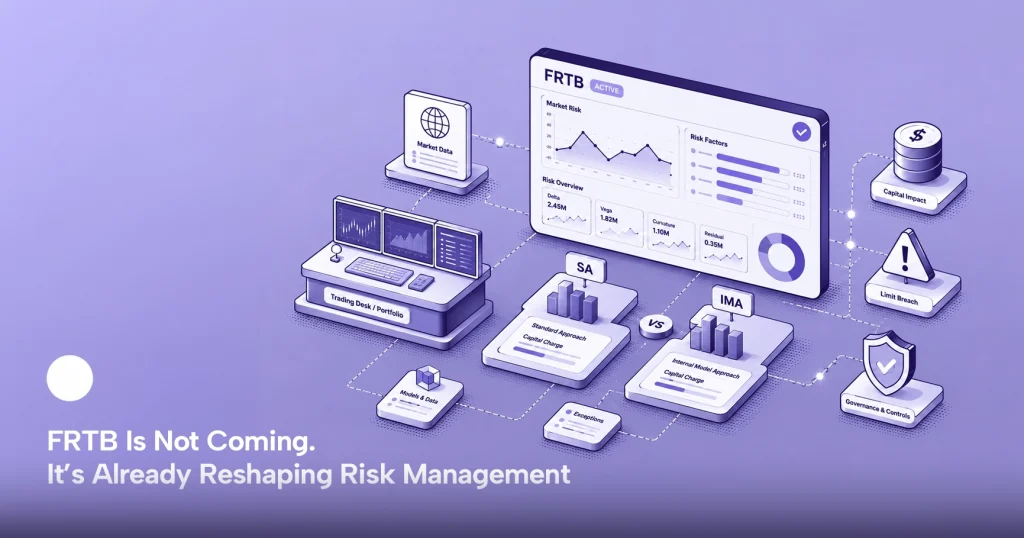
FRTB Is Not Coming. It’s Already Reshaping Risk Management
For years, FRTB has been treated as a future problem. Something sitting on the regulatory calendar. Something for market risk teams to prepare for, model teams to debate and technology teams to eventually implement. The deadline mattered, of course. But the tone around it was often strangely distant, as if FRTB would only become real when the official date arrived.
That reading is becoming harder to defend.
FRTB is already changing risk management because it is changing the questions banks need to answer now. Which trading desks will remain capital-efficient under the new framework? Which portfolios look different under the standardized approach? Where does the Internal Models Approach still justify the operational burden? Which sensitivities are clean enough, fast enough and explainable enough? Which systems can support the level of calculation, attribution and governance the new market risk regime requires?
These are not future questions. They are current business questions.
In the UK, the Prudential Regulation Authority has now confirmed that Basel 3.1 will take effect on January 1, 2027, while the implementation of FRTB-IMA has been pushed to January 1, 2028. The extra year gives firms more time to prepare for internal models, but it does not pause the market risk transition. From 2027, firms with existing IMA permissions enter an interim period, while positions outside current permissions move to the new standardized approaches. Existing IMA permissions will also not simply be carried forward when FRTB-IMA goes live in 2028, meaning firms that want to continue using internal models will need to apply under the new Basel 3.1 rules.
FRTB was born out of a very real failure of the old market risk framework. The global financial crisis exposed weaknesses in how banks measured trading book risk, how capital was assigned, and how much confidence supervisors could place in model-based numbers. The Basel Committee’s revised market risk framework was designed to address those weaknesses, replacing the previous standard and integrating a more risk-sensitive approach to capital for trading activities.But in practice, FRTB is not just a capital rule. It is a stress test of how a bank thinks about its trading business.
The standardized approach is not a simple fallback. It demands better sensitivities, cleaner data, more consistent aggregation and a sharper view of what is actually driving capital. The Internal Models Approach is not simply a badge of sophistication either. It brings a heavier burden around desk-level approval, Expected Shortfall, liquidity horizons, non-modellable risk factors, P&L attribution and model governance. For some desks, IMA may still be strategically valuable. For others, the cost of maintaining it may be harder to justify.
That is where the executive conversation starts.
FRTB forces banks to look beyond the regulatory number and ask what the number means for the business. If a desk becomes materially more capital-intensive under SA, is the bank prepared to explain why? If IMA reduces capital but increases governance and infrastructure costs, is the trade-off still attractive? If sensitivities are inconsistent across systems, can the bank trust the output? If P&L attribution fails, what does that say about the desk, the model or the data underneath it?
These are not questions that should be answered in the final stretch before implementation. They require time, evidence and iteration.
The most dangerous phrase in a transition like this is “we still have time.” Banks heard versions of that before other major regulatory and market shifts. The institutions that prepared early were not always the ones with the biggest programs. They were the ones with earlier visibility. They knew where capital was moving, where infrastructure was weak, where data quality would create friction and where the business needed to make strategic choices.
FRTB will reward that kind of visibility
It will also expose the opposite. A bank that treats FRTB as a late-stage compliance project may eventually produce the required numbers, but that is not the same as understanding them. Producing a capital calculation is one thing. Explaining why it moved, what drove it, which desks are affected and what options the business has is another. The real test is not whether the bank can calculate FRTB once. It is whether the bank can make FRTB part of the way it manages market risk.
For a long time, market risk systems were seen mainly as reporting engines. They calculated, reconciled, stored and produced outputs for risk committees, regulators and internal control functions. Under FRTB, that view becomes too narrow. Market risk infrastructure becomes business infrastructure because the speed and quality of the analytics affect trading decisions, capital allocation, desk strategy and profitability.
A slow system does not only slow down reporting. It slows down understanding.
If a bank cannot run FRTB SA analytics quickly, it cannot easily compare portfolios or explain capital movements. If it cannot evaluate IMA scenarios with enough granularity, it cannot decide where internal models are worth pursuing. If outputs arrive too late, the business conversation moves ahead without them. In that environment, infrastructure is no longer a technical detail. It becomes part of the bank’s ability to compete.
This is also why the UK transition period should be treated as an active window, not a holding pattern.
The market has already seen what happens when risk moves faster than internal systems. The 2008 crisis exposed the limits of model confidence and capital assumptions in trading books. More recently, episodes of extreme volatility, liquidity stress and rapid repricing have reminded banks that risk can move across desks, products and counterparties faster than governance cycles expect. FRTB is not a response to one single event. It is part of a broader post-crisis shift toward making market risk capital more credible, more comparable and more sensitive to the actual risks banks run.
For executives, the practical issue is simple: the framework may be regulatory, but the consequences are commercial.
Capital is not neutral. If FRTB changes how capital is consumed, it changes how desks are evaluated. It changes the economics of certain products. It changes the conversation between front office, risk and finance. It may influence which businesses receive investment, which require restructuring and which become less attractive under the new regime.
This is where many FRTB programs risk becoming too technical too quickly. The conversation gets pulled into formulas, buckets, liquidity horizons, modellability tests and attribution thresholds. All of that is necessary. But the strategic question sits above it: can the bank see the impact early enough to make better decisions?
That is where Vector Risk has a relevant role.
Vector Risk is positioned around high-performance, cloud-native risk analytics, including support for FRTB SA and IMA, alongside VaR, PFE, xVA, SA-CCR and ISDA SIMM. For banks facing the FRTB transition, the value is not just having another calculation engine. It is having a faster way to test the framework in practice, using real data, before committing to a long implementation path.
That pilot-led approach is important because FRTB readiness cannot be assessed properly in theory. A bank needs to see how the platform handles its portfolios, its sensitivities, its calculation requirements and its operating reality. It needs to compare outputs, identify gaps, test performance and understand what the numbers mean for the business. A demo can explain capability. A pilot can reveal fit.
The timing also matters. With Basel 3.1 live in the UK from 2027 and FRTB-IMA following in 2028, banks have a window to make better decisions. They can use the transition to understand SA impact, test IMA ambition, assess data quality and build confidence across risk, finance, front office and technology. Or they can wait until the deadline gets closer and discover the hard parts under pressure.
FRTB is often discussed as a burden, and in many ways it is. It adds complexity, calculation demand, governance and data pressure. But for banks that move early, it can also create clarity. It can show where capital is being consumed, where the trading book is efficient, where the operating model is fragile and where infrastructure needs to evolve.The banks that act first will not simply be more compliant. They will understand more.
They will understand which desks are affected before the numbers become a board-level surprise. They will understand whether IMA is worth the cost before the application timeline becomes compressed. They will understand where standardized capital charges create pressure. They will understand which data problems are technical irritations and which are strategic constraints.
That is the real advantage of FRTB readiness.
Not checking the regulatory box. Not building a massive transformation program for its own sake. Not waiting for perfect certainty from every jurisdiction. The advantage is evidence: earlier, cleaner and closer to the business.
FRTB is not coming. It is already reshaping the way banks think about market risk, capital, trading books and infrastructure. The only question is whether institutions will treat this period as extra time to wait or as the window to understand what the new framework means for their business.
Vector Risk gives banks a faster way to start that work. With pre-configured analytics for FRTB SA and IMA, institutions can run a focused pilot, test the platform with their own data and move from regulatory uncertainty to practical insight.
Because in FRTB, readiness will not belong to the banks that wait the longest.It will belong to the banks that know sooner.
Run a Vector Risk pilot. Prove FRTB readiness with your own data.
References
- Prudential Regulation Authority / Bank of England – PS1/26: Implementation of Basel 3.1: Final rules – Reference for the UK Basel 3.1 implementation date of January 1, 2027, the delay of FRTB-IMA to January 1, 2028, and the interim treatment of existing IMA permissions and positions outside those permissions https://www.bankofengland.co.uk/prudential-regulation/publication/2026/january/implementation-of-the-basel-3-1-final-rules-policy-statement
- Prudential Regulation Authority / Bank of England – Basel 3.1 permissions – Reference for the PRA’s approach to Basel 3.1 model permissions, including new IMA applications and the transition into the revised market risk framework. https://www.bankofengland.co.uk/prudential-regulation/authorisations/capital-requirements-regulation-permissions/basel-3-1-permissions
- Basel Committee on Banking Supervision – Minimum capital requirements for market risk – Primary Basel reference for the revised market risk framework, replacing the earlier version of the standard and later integrated into the consolidated Basel Framework. https://www.bis.org/bcbs/publ/d457.htm
- Basel Committee on Banking Supervision / Financial Stability Institute – Revised market risk framework: Executive Summary –
Reference for the rationale behind the Fundamental Review of the Trading Book and the weaknesses in the previous market risk capital framework.
https://www.bis.org/fsi/fsisummaries/rmrf.pdf - ICMA – Fundamental Review of the Trading Book – Useful market-facing reference explaining FRTB as a Basel Committee initiative to revise minimum capital requirements for market risk and address industry concerns around the framework. https://www.icmagroup.org/market-practice-and-regulatory-policy/secondary-markets/secondary-markets-regulation/fundamental-review-of-the-trading-book-frtb/
- McKinsey -FRTB reloaded: The need for a fundamental revamp of trading-risk infrastructure – Reference for FRTB’s impact on trading risk infrastructure, including Expected Shortfall, revised standardized approach, non-modellable risk factors, P&L attribution and desk-level approvals. https://www.mckinsey.com/capabilities/risk-and-resilience/our-insights/frtb-reloaded-the-need-for-a-fundamental-revamp-of-trading-risk-infrastructure
- Reuters – Bank of England delays Basel rule on banks’ trading to 2028 – Market news reference for the Bank of England’s one-year delay of FRTB-IMA to January 2028, while broader Basel 3.1 rules remain set for January 2027. https://www.reuters.com/sustainability/boards-policy-regulation/bank-england-delays-basel-rule-banks-trading-2028-2025-07-15/
- Reuters – BNP Paribas CEO says EU likely to delay trading book capital rules – Reference for wider industry uncertainty and potential EU delays around FRTB implementation, showing why banks face a fragmented transition rather than a simple single-date deadline. https://www.reuters.com/sustainability/boards-policy-regulation/bnp-paribas-ceo-says-eu-likely-delay-trading-book-capital-rules-2025-10-28/
- Vector Risk – Official Website – Reference for Vector Risk’s cloud-hosted, high-performance risk analytics and
support for VaR, FRTB SA & IMA, PFE, xVA, SA-CCR and ISDA SIMM. https://www.vectorrisk.com/