

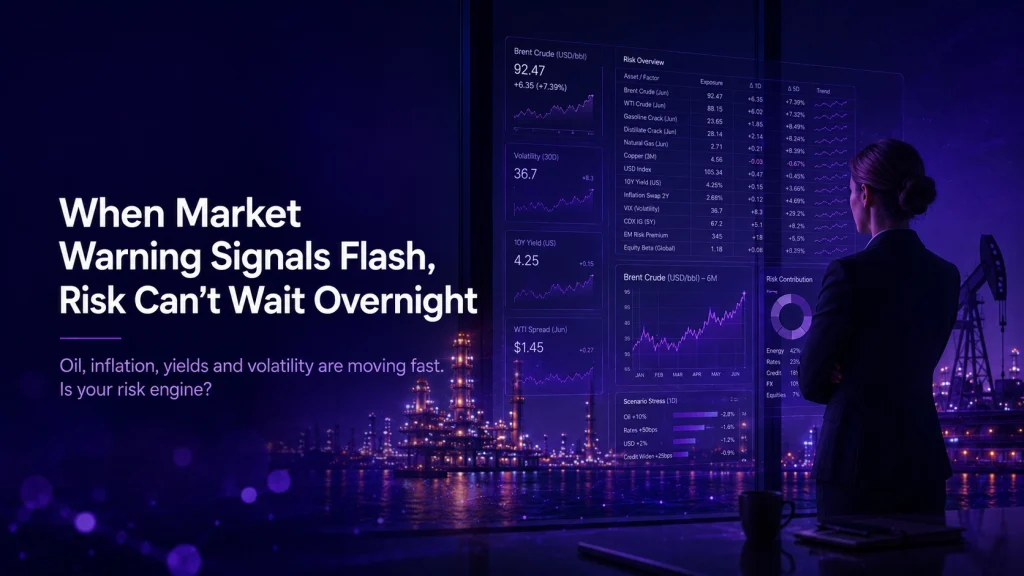
When Market Warning Signals Flash, Risk Can’t Wait Overnight
Markets have a way of warning before they break. Not always clearly. Not always politely. Never in a way that fits neatly into a risk committee calendar.
This week, the warning lights are flashing again. Reuters reported that several measures of financial stress are moving back toward critical levels as markets digest a volatile mix of elevated oil prices, Middle East tensions, inflation pressure, long-term U.S. yields, widening credit spreads, heavy investor leverage and sharp moves in the Japanese yen. The article also pointed to renewed doubts around the AI-led equity rally, adding another layer of pressure to a market already trying to price geopolitics, rates and liquidity at once.
For traders, this is a market story. For risk teams, it is an infrastructure story.
Because when stress starts to travel across asset classes, the question is not only whether a bank can identify the risk. It is whether the bank can calculate it, explain it and act on it fast enough.
That distinction matters. A market can reprice in minutes. A funding curve can move before the next scheduled batch run. A counterparty exposure can change before yesterday’s report reaches the right desk. A portfolio that looked balanced at the close can look materially different after an oil shock, a rates move or a currency dislocation.
In quiet markets, slow infrastructure can look acceptable. In stressed markets, it becomes a blind spot.
The current backdrop is uncomfortable because it is not a single shock. It is a cluster. Oil remains politically sensitive because of the Middle East. Inflation expectations remain vulnerable to energy prices. Long-term yields continue to shape the cost of capital. Credit spreads are widening in parts of the market. Investor leverage is high. The yen is weak enough to raise questions about carry trade fragility. Reuters noted that margin debt has reached record levels and that long-term U.S. Treasury yields have stayed above 5% for a historically long stretch, while the yen has fallen to multi-decade lows.
Each of these signals matter on their own. Together, they create a more dangerous problem: correlation risk.
That is where risk engines are tested.
A higher oil price is not just an energy-market event. It can feed inflation, affect rates expectations, pressure importers, move currencies and reprice credit. Higher long-term yields are not just a bond-market story. They affect discount rates, bank books, corporate borrowing costs, leveraged positions and equity valuations. A sharp yen move is not just foreign exchange volatility. It can disturb carry trades, force deleveraging and spill into broader risk appetite.
In other words, the risk is not sitting in one place.It moves through the system.
That is why modern market risk management cannot depend on static reporting. It needs a faster operating rhythm. A bank needs to know not only that VaR moved, but which risk factors drove the move. It needs to know not only that Expected Shortfall increased, but whether the tail is coming from rates, FX, credit, commodities or cross-asset concentration. It needs to know not only that a stress scenario is worse, but which portfolio, desk or counterparty is creating the pressure.
A slow system does not simply slow down reporting. It slows down understanding. And in markets like this, understanding has a price
The old risk operating model was built around a different tempo. One where calculations could run overnight and reports could be distributed the next morning. One where committees could review what happened and technology teams could reconcile outputs. Risk managers could explain the previous day’s numbers.
That rhythm is no longer enough
The market does not wait for overnight batches. It does not wait for local infrastructure to finish a calculation. It does not wait for teams to reconcile fragmented outputs across systems.
This is particularly true when risk signals become mutually reinforcing. A rates move affects valuation. A valuation move affects margin. Margin pressure affects liquidity. Liquidity stress affects spreads. Spreads affect counterparty risk. Counterparty risk affects capital and limits. By the time the full chain is visible, the business may already have made decisions using incomplete information.
For banks, this creates a practical problem. The risk function is expected to support faster decisions with infrastructure that, in many institutions, was not designed for that speed.
The issue is not whether banks understand VaR, Expected Shortfall, stress testing or PFE. They do. The issue is whether these calculations can be run with enough speed, flexibility and consistency to be useful while the market is moving.
VaR remains a core measure of potential loss under normal market conditions. Expected Shortfall gives a deeper view of the tail, particularly when losses move beyond the VaR threshold. Stress testing helps institutions understand how portfolios behave under severe but plausible scenarios. PFE is critical for understanding how counterparty exposure may evolve over time. Together, these measures form part of the language of modern financial risk.But language is not enough. Timing matters.
A VaR number that arrives too late is a historical artifact. An Expected Shortfall calculation that cannot be refreshed under new market assumptions is an incomplete view of the tail. A stress test that cannot be adjusted quickly becomes a compliance exercise rather than a management tool. A PFE profile that cannot keep pace with market moves weakens the conversation around counterparty credit risk, collateral and limits.
The value of risk analytics is not only in the calculation. It is in the ability to use the calculation when decisions are still open. That is why the current market environment should make banks look closely at their risk engines.
Can the platform handle new scenarios quickly? Can it run calculations across portfolios without turning every request into a technology project? Can it support conversations between risk, finance and front office with numbers that are timely, explainable and consistent? Can it scale when volatility rises and the demand for analytics increases? Can it help the business compare risk before and after a market move, not days later?
These questions are becoming more commercial than technical.
In a volatile market, risk infrastructure affects capital allocation. It affects desk strategy. It affects client activity. It affects limit management. It affects the ability to see concentration before it becomes a loss event. It affects how confidently a bank can respond to supervisors, boards and senior management when the market starts asking harder questions.
The risk engine, in this context, becomes part of the bank’s decision infrastructure.
That is a shift many institutions are still absorbing. For years, risk systems were often treated as reporting utilities: essential, expensive and mostly operational. Their job was to produce numbers for control functions, regulators and internal governance.
But when markets are fast, risk systems become strategic.
They influence how quickly an institution can see the impact of a rates shock. They influence whether a desk can understand capital consumption before taking on more exposure. They influence whether counterparty credit risk teams can identify changing PFE profiles before a limit conversation becomes urgent. They influence whether senior management receives analysis in time to act, or only in time to explain.
This is where cloud-native risk analytics changes the conversation.
Cloud is not valuable because it sounds modern. It is valuable because market stress is uneven, computationally heavy and time-sensitive. Risk teams do not need the same amount of compute every day. They need the ability to scale when the market demands it. They need to run more scenarios, more portfolios and more analytics without being trapped by local infrastructure constraints.
When volatility rises, the demand for risk insight rises with it. That is precisely when slow systems become most visible.
Vector Risk was built for this environment.
The platform provides high-performance, cloud-hosted risk analytics across VaR, FRTB SA and IMA, PFE, xVA, SA-CCR and ISDA SIMM, with supporting analytics including VaR, backtesting and theoretical P&L. Vector Risk also states that vectorisation can deliver an 80 times speed-up over normal code.
For banks facing today’s market conditions, that speed is not a convenience. It is the difference between using risk analytics as a live decision tool and treating it as an after-the-fact reporting layer.
When Reuters describes stress signals moving toward critical levels, the key takeaway for financial institutions is not panic. It is preparedness. Preparedness means being able to ask sharper questions while there is still time to respond.
● What happens to VaR if oil volatility remains elevated?
● How does Expected Shortfall behave if long yields stay higher for longer?
● Which portfolios are most exposed to a yen reversal?
● Where do credit spread moves hit hardest?
● How does PFE evolve if volatility persists?
● Which counterparties, products or desks become more material under
● stressed assumptions?
These are not theoretical questions. They are the operating questions of risk management in a market that can move across commodities, rates, FX, credit and equities at the same time.
And they cannot be answered properly with yesterday’s infrastructure.
The best banks will not be the ones that wait for volatility to become a crisis before upgrading their analytics. They will be the ones that treat these warning signals as a prompt to test their own readiness.
That does not always mean starting with a massive transformation program. In many cases, the smarter move is more focused: test the platform with real portfolios, real data and real calculation demands. See how the analytics perform. Compare outputs. Identify gaps. Understand where speed changes the quality of the business conversation.
This is why Vector Risk’s pilot-led approach matters.
A presentation can describe performance. A pilot can prove it. A demo can show capability. A pilot can reveal whether the system fits the bank’s portfolios, workflows and risk reality. In an environment where market signals are already flashing, that distinction is important.
Banks do not need another theoretical conversation about modernization. They need evidence.They need to know whether their risk engine can keep up with the market.They need to know whether VaR, Expected Shortfall, stress testing and PFE can move from static reporting to faster decision intelligence.
They need to know whether cloud-based analytics can help risk teams respond to volatility while the information is still actionable.The market is already asking the question.
Oil is moving. Yields are pressuring valuations. Credit spreads are widening. The yen is testing old assumptions. Investor leverage is high. Equity leadership is showing cracks. Geopolitics remains a live wire. Inflation is not fully settled. In this global environment, risk cannot wait overnight.
It has to be calculated faster. Explained faster. Tested faster. Challenged faster. And understood before the market moves again.
Vector Risk helps banks start there: with a focused test, using their own data, to see how faster cloud-native risk analytics can change the way they manage market risk.
Because when warning signals flash, the real question is not whether the market is stressed.
It is whether your risk engine is fast enough to see what comes next.
Test Vector Risk with your own data. Run a focused pilot and see how fast your risk engine can move.
Jabuticaba’s model is a free, no-obligation pilot setup designed to help your team test the platform with its own data before committing.
References
- Reuters “Market warning signals flare again as tech, inflation fears intensify”
Reference for the renewed market stress signals, including oil prices, Middle East tensions, inflation pressure, long-term yields, credit spreads, investor leverage, yen volatility and pressure on the AI-led equity rally.
Link: https://www.reuters.com/business/finance/global-markets-stress-graphic-2026-07-28/ - Reuters “Oil prices fall 2% on hopes for US-Iran conflict easing”
Reference for current oil price movement and the connection between Middle East geopolitical risk, energy supply concerns and market sentiment.
Link: https://www.reuters.com/business/energy/oil-prices-fall-1-investors-weigh-pause-us-strikes-iran-2026-07-28/ - Reuters “Dollar eases as oil prices fall on pause in Middle East conflict”
Reference for the relationship between oil, the dollar, the yen, risk appetite and central bank expectations during the current geopolitical environment.
Link: https://www.reuters.com/markets/currencies/dollar-eases-oil-prices-fall-pause-middle-east-conflict-2026-07-27/ - Reuters “Dollar eases as oil prices fall on pause in Middle East conflict”
Reference for the relationship between oil, the dollar, the yen, risk appetite and central bank expectations during the current geopolitical environment.
Link: https://www.reuters.com/markets/currencies/dollar-eases-oil-prices-fall-pause-middle-east-conflict-2026-07-27/