
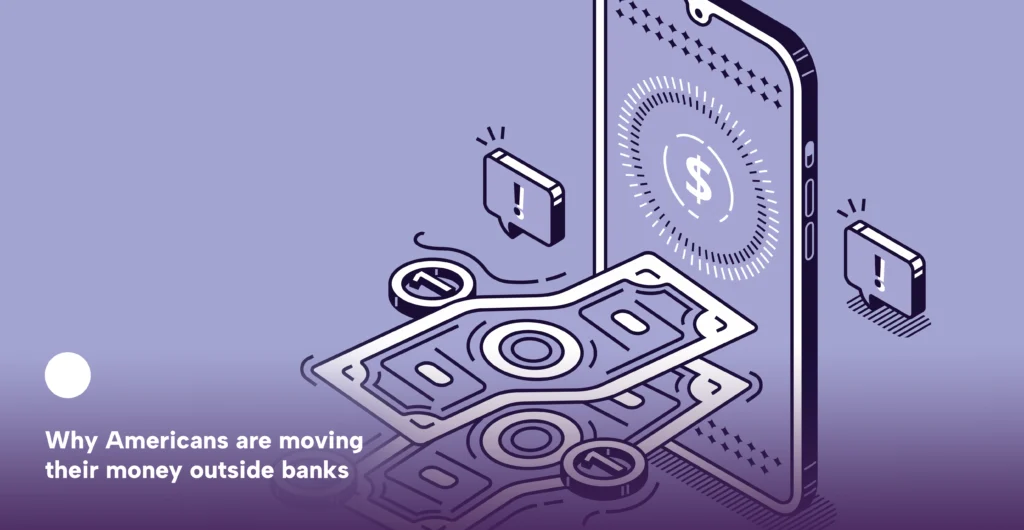
Why deposits are leaking out of banks and what ALCO needs to understand now.
The Quiet Migration Away From Banks
Not every consumer is choosing a bank anymore. And that shift is reshaping the liquidity landscape for community and regional institutions. Over the last decade, U.S. financial behavior has undergone a structural change: Consumers haven’t become “unbanked.”
They’ve become differently banked.
From neobanks to fintech apps, payroll cards, money-market funds, BNPL platforms, and even stablecoins, Americans now have more alternatives than at any point in modern banking history. For banks, especially those under $5B in assets, this raises a critical question:
“Where is consumer cash going and how much liquidity risk does this create for traditional deposit bases?”
Understanding non-bank alternatives is no longer a marketing exercise. It is an essential part of balance-sheet forecasting, ALCO decision-making, and funding stability management.
This article breaks down the main categories of non-bank financial options, why consumers are choosing them, and how banks can model deposit outflows using BARK — Balance Sheet Analysis, Regression and ForeCasting.
The Five Categories of Non-Bank Alternatives
Consumers are not leaving banks randomly, they are selecting specific alternatives based on speed, cost, yield, and digital experience.
Below are the five major destinations for liquidity outside the traditional banking system.
1. Neobanks & Digital-Only Accounts: Chime, Varo, Current
The rise of neobanks has been driven by simplicity, real-time features, and fee elimination. Why consumers choose them:
- No overdraft fees;
- Early access to paychecks;
- Instant notifications;
- Strong mobile experience.
The Federal Reserve’s 2023 Payments Study shows that digital-only accounts continue to grow sharply, especially among younger consumers and gig-economy workers.
Impact on banks: these accounts siphon off primary checking relationships, lowering the stickiness of deposits that have been traditionally held at community institutions.
2. Prepaid & Payroll Cards: Green Dot, Netspend, Wisely
FDIC research shows that 6.5% of U.S. adults rely on prepaid cards regularly, disproportionately among lower-income households and workers without the classic W-2 payroll cycles.
Why consumers choose them:
- Predictable costs;
- No credit checks;
- Easy on-ramp for the underbanked;
- Immediate access to funds.
Impact on banks: prepaid cards reduce the volume of entry-level accounts — historically critical for deposit growth pipelines.
3. Buy Now, Pay Later (BNPL): Affirm, Klarna, Afterpay
BNPL has become one of the fastest-growing non-bank credit channels. According to the Consumer Financial Protection Bureau (CFPB), BNPL transaction volume grew 17× between 2019 and 2022.
Why consumers choose BNPL:
- No traditional credit checks;
- Predictable installment payments;
- Frictionless online integration.
Impact on banks: BNPL reduces usage of:
- Credit cards;
- Personal loans.
- Overdraft services.
This shifts revenue away from banks and also masks consumer credit stress, since these debts sit outside the bank’s visibility.
4. Brokerage Apps & “Cash as Investments”: Robinhood, Fidelity, Schwab Cash Management
In a high-rate environment, consumers discovered something powerful: Money Market Funds offer 5%+ yields, while average bank savings rates remain below 1%.
The Investment Company Institute (ICI) reported that more than $1 trillion moved into money-market funds in 2023 alone.
Why consumers choose them:
- Far superior yields;
- Same-day liquidity;
- Intuitive digital platforms.
Impact on banks: this is one of the most significant sources of deposit outflow today.
Funds migrate from low-yield checking/savings directly to MMFs, creating structural pressure on: liquidity, funding costs, NIM, balance-sheet stability. This is one of the clearest examples of deposit “leakage” into non-bank channels.
5. Crypto & Stablecoins (Used as Digital Cash Equivalents)
Even with declining speculative activity, stablecoins are still widely used for payments, remittances, and online transfers.
Chainalysis reports that USDC and USDT transaction volume in 2024 exceeded $3.5 trillion, driven largely by consumer-to-business and peer-to-peer flows.
Why consumers choose them:
- Low fees;
- 24/7 settlement;
- Easy cross-border use.
Impact on banks: Stablecoins compete directly with: wires, ACH, small-value checking accounts.And they operate outside the traditional deposit framework, reducing visibility for banks.
Why Consumers Are Choosing Non-Bank Alternatives
The migration away from banks is not accidental, it’s behavioral. Top drivers (with real data) include:
- Fees: CFPB data shows overdraft and NSF fees exceeded $12 billion annually prior to regulatory pressure, making alternatives attractive.
- Low yields: At the peak of 2023, bank savings accounts averaged 0.46% APY, while MMFs paid more than 5% (FRED data).
- Convenience & UX: Neobanks and fintech apps provide instant transfers, visibility, and speed that many traditional banks still lack.
- Distrust after the 2023 regional banking crisis:Federal Reserve surveys indicate consumer trust dipped after several high-profile bank failures.
- Gig economy growth: Non-traditional work increases demand for flexible, mobile-first financial tools.
How deposit flow is shifting away from banks
When consumers move cash to non-bank channels, the results are measurable:
- Lower sticky balances: transactional deposits held at banks fall as consumers keep money in: MMFs, brokerage cash accounts, digital wallets.
- Increased volatility: money in fintech ecosystems moves faster and responds more aggressively to shocks.
- Funding pressure: banks must replace lost deposits with more expensive wholesale funding.
- Reduced visibility into consumer credit risk,
Case Study: Money Market Funds vs. Banks (2023 Liquidity Shift)
According to the SEC and Investment Company Institute, U.S. MMFs saw inflows of more than: $1.1 trillion between January and December 2023
This coincided with: rising interest rates, regional bank failures, widening concern about uninsured deposits. Deposits flowed out of banks into MMFs at a scale not seen since the 2008 crisis.
Community banks were hit hardest: their customer base is rate-sensitive but often lacks high-yield alternatives internally.
Implications for ALCO: The New Competitive Landscape
When liquidity leaks into non-bank channels, ALCO faces new challenges:
- Behavioral assumptions must change – Deposit stickiness has structurally weakened.
- Liquidity scenarios must incorporate fintech competition – It’s no longer enough to model interest-rate sensitivity, banks must model ecosystem sensitivity.
- Funding strategies must shift, with deposits moving elsewhere, banks rely more heavily on: FHLB advances, brokered deposits, wholesale funding. All of which increase cost and reduce margin
How BARK Helps Banks Quantify These Shifts
Banks don’t just need to understand deposit migration.They need to measure it. BARK — by Jabuticaba — gives institutions a structured way to model the impact of non-bank competition.
1. Balance Sheet Analysis
BARK shows how macro trends (MMF yields, BNPL penetration, fintech adoption) correlate with internal deposit behavior.
It helps ALCO see:
- Which deposit categories are most vulnerable;
- Which consumer profiles are migrating;
How liquidity patterns shift in response to market rates and digital alternatives.
2. Regression
Regression analysis reveals:
- Historical relationships between deposit changes and external financial alternatives;
- How rate differentials impact deposit runoff;
- Early indicators of structural shifts.
This exposes hidden risks often invisible in raw balance-sheet data.
3. ForeCasting
BARK allows banks to run scenarios such as:
- “What happens if 10% of checking deposits move to money-market funds?”;
- “How will BNPL adoption affect consumer cash flow next quarter?”;
- “What is the liquidity impact if fintech wallet usage grows 15%?”;
The tool delivers clear, institution-specific projections, supporting:
- ALCO decision-making;
- Liquidity planning;
- Contingency funding strategies;
- Regulatory reporting.
Everything is transparent, business-oriented, and easy to interpret.No AI. No black boxes.
Just rigorous Balance Sheet Analysis, Regression and ForeCasting.
Banking Is No Longer the Only Game in Town
Consumers are not abandoning financial services. They’re choosing new ones. The rise of non-bank alternatives is not only structural, behavioral and macro-sensitive, but deeply relevant to bank balance sheets.
For community and regional banks, this is not a threat, it is a data point. A trend that can be quantified, forecasted, and managed. Tools like BARK make that possible.
Try BARK free before you buy.See how non-bank alternatives may reshape your balance sheet and prepare with confidence.
References (Oxford Style)
Consumer Financial Protection Bureau (CFPB). (2023). Buy Now, Pay Later: Market Trends and Consumer Impacts. Available at: https://www.consumerfinance.gov/ (Accessed 10 Dec 2025).
Federal Deposit Insurance Corporation (FDIC). (2023). National Survey of Unbanked and Underbanked Households. Available at: https://www.fdic.gov/analysis/household-survey/ (Accessed 10 Dec 2025).
Federal Reserve. (2023). Payments Study. Available at: https://www.federalreserve.gov/paymentsystems.htm (Accessed 10 Dec 2025).
Federal Reserve Economic Data (FRED). (2023). Money Market Fund Assets; Savings Rates. Available at: https://fred.stlouisfed.org/ (Accessed 10 Dec 2025).
Investment Company Institute (ICI). (2024). Money Market Fund Statistics. Available at: https://www.ici.org/ (Accessed 10 Dec 2025).
Securities and Exchange Commission (SEC). (2023). Money Market Fund Flow Data. Available at: https://www.sec.gov/ (Accessed 10 Dec 2025).
Chainalysis. (2024). Global Crypto Adoption Index. Available at: https://www.chainalysis.com/ (Accessed 10 Dec 2025).
U.S. Census Bureau. (2023). Commuting Patterns. Available at: https://www.census.gov/ (Accessed 10 Dec 2025).
Learn more at jabuticaba.app or start your free BARK trial today.